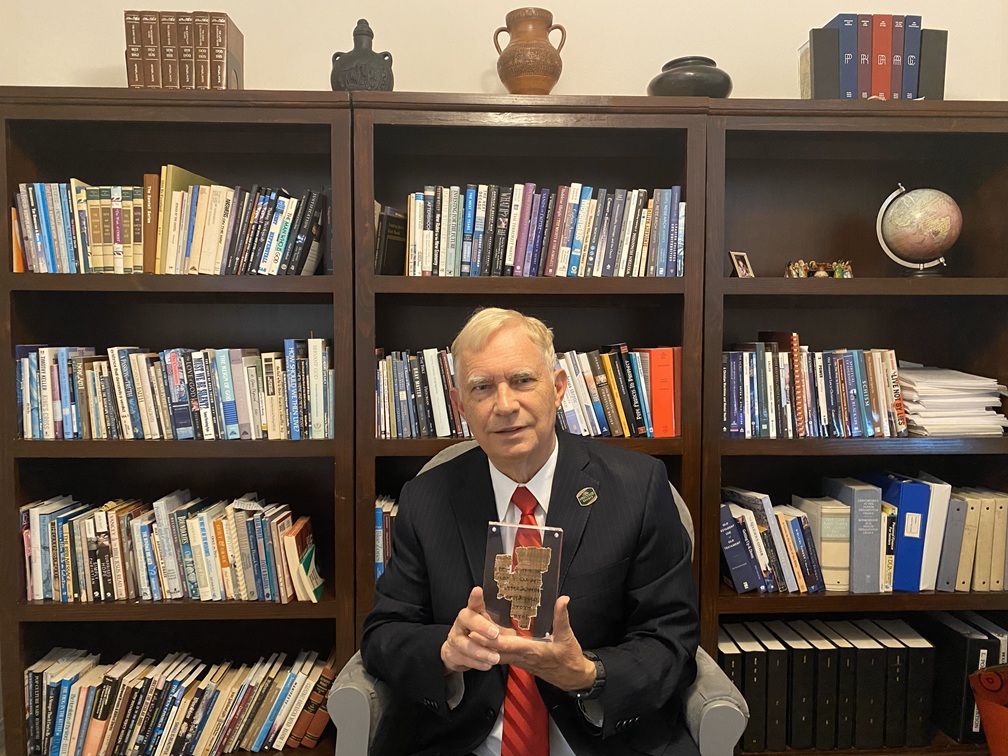
Hello! I am Jon Paulien and I’m glad you came to this page to check out my work. I am a New Testament scholar and Professor of Religion at Loma Linda University. On this website you will find a collection of my articles, commentary on Revelation, and links to my blog, videos, and other resources. Make sure you check the articles link above regularly to see the latest postings. In my hand above is an exact replica of p52, the earliest extant New Testament manuscript fragment, containing portions of John, chapter 18. Centered above my head is a replica of ancient Greek pottery. At either end above are two sets of books from, and about, my favorite spiritual author, Ellen G. White. I hope you enjoy the site.
Daily Devotional For October 27, 2026
View in the Daily Devotional Index
The kings of the earth, who committed fornication with her and lived luxuriously, will weep and mourn over her when they see the smoke of her fiery ordeal. They stand at a distance, for fear of her torment, saying, “Woe, woe is Babylon, the great city, the strong city, because in one hour your judgment has come.” Rev 18:9-10.
The situation of End-time Babylon would have rung a bell with people in first-century Asia Minor. The “kings of the earth” in this text would probably have been seen as the client kings (like Herod in Palestine) that ruled in Rome’s behalf in the provinces. They would keep their distance from the destruction out of self-preservation. Both then and now, love for “Babylon” is a self-interested love, it is not self-sacrificing love.
In the First Century Rome was the engine that drove the prosperity of the Empire. Rulers in the provinces profited greatly from Roman rule. Many would not have risen to power and status were it not for the emperor’s patronage. Rome provided security and prosperity for its friends. And Asia, where John was located, was the richest of the provinces.
But one reason Rome was so prosperous was that her luxury came at the expense of many. 400,000 tons of grain came annually to the capital from Egypt, North Africa and the Black Sea region. While provincials paid inflated prices for grain and sometimes had none, 200,000 families in Rome received a regular dole of free grain from the government.
Rome’s appetite for luxury and wealth lured many wealthy provincials to invest in products they could export to Rome rather than what the locals needed. Land owners in Asia Minor used so much land for export items like wine that Asia’s cities had to import grain from Egypt and other areas. So the landowners profited from their relationship with Rome, but the common people had to pay high prices for their basic food needs (see Rev 6:5-6).
Rome’s commercial interests also propagated its religion, so people who wanted to buy and sell to Rome had to worship in exchange for the privilege. John no doubt enjoyed the irony of this vision. It is no wonder that the merchants and rulers in the provinces lament. They had sold their soul to the system that pampered them and now that system was gone!
Jews were exempt from the religion of Rome, so they were able to buy and sell around the system. But Christians of the first century who were kicked out of the synagogue would have to choose between participating in pagan worship or losing their access to income. In the last days, similar challenges will take place in the world.1
Lord, help me see the degree to which wealth and power motivate my actions rather than faithfulness to You.
1 Based on Keener, 426-427.